

Table of Contents
Introduction
My local women’s football team is called the London Bees and they are based in Edgware, North West London. They are a non-League Team playing in the fourth step of the English Women’s Footballing Pyramid. I will explain a bit more about this in a moment. For now, I will talk about the game and our experiences, how the English Women’s Footballing Pyramid works and then touch on when different levels collide which is the magic of the Women’s FA Cup.
The London Bees – A History
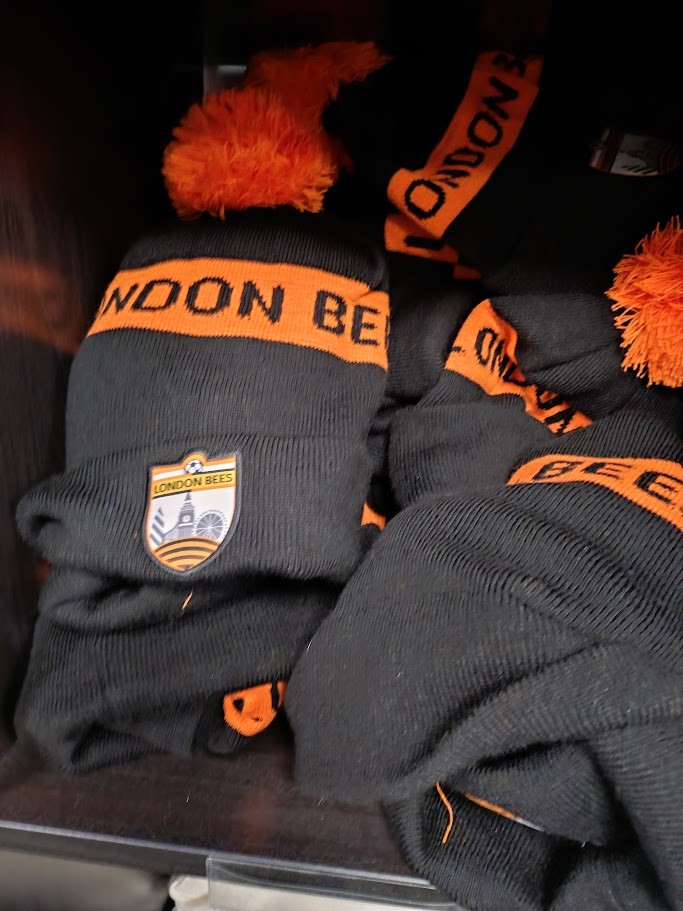
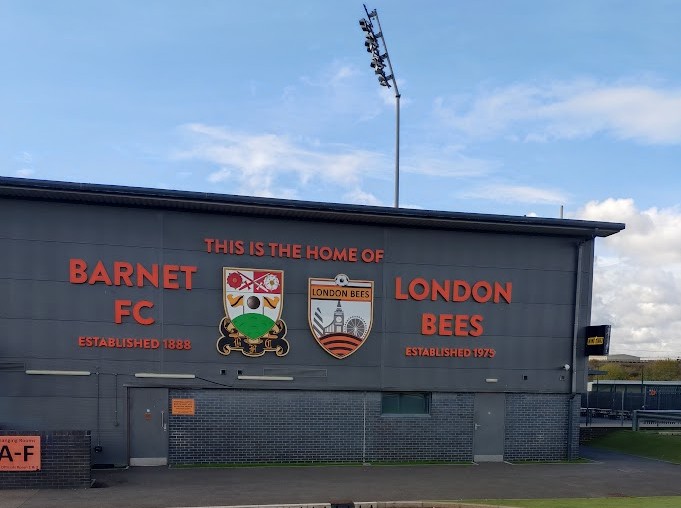
The London Bees themselves were formed in 1975 and are now owned by the Owner of Barnet Football Club which is a men’s professional football club playing in League Two of the English Football League. Their history is long and checkered – starting out as being the team for the Ladies of the London Underground’s District Line (which is the green line which goes from East to West) with the official name of District Line Ladies FC.
The London Bees then went through multiple different name changes, mergers and splits until they now find themselves affiliated with Barnet FC – although these days they are NOT Barnet FC’s Women’s Team. They did once play in what is now called the WSL 2 (the Women’s Super League 2) – or second Tier before suffering many relegations to fall into the non-League situation.
Under a previous incarnation of Wembley Ladies FC (after a merger with Wembley FC), they even reached the Women’s FA Cup Final in 1997 losing to Millwall Lionesses. Interestingly, Millwall Lionesses – then part of Millwall FC – split from that club and have now become the new juggernauts of London City Lionesses including the world’s best woman player – Alexia Putellas.
When I started following them in 2024, they had just been relegated to the FA Women’s National League Division 1 South East and had to rebuild from scratch under new Manager Dan McKimm.
A Guide to the English Women’s Football Pyramid
Before we cover a review of the game from the FA Women’s National League Division 1 South East: London Bees v Chatham Town, let’s start with an overview of how English Women’s Club Football actually works.
There are overall 13 levels to the English Women’s Football Pyramid broken down into three main categories:
- National – Tier 1 and 2
- Semi-National Tiers 3 to 4
- Regional – Tiers 5 to 6
- County – Tiers 7 to 13
The official English FA Handbook 2026/27 clarifies that – the “Women’s Football Pyramid” means the system of women’s leagues controlled by The Association where promotion and relegation links exists between the participating Leagues.
National – Tier 1 and 2
At the National Level, we have the world-famous WSL (Barclay’s Women’s Super League) – one of the most important – if not actually the most important – women’s domestic League. The WSL features 14 Teams and is sponsored by a major British bank alongside other major sponsors with Barclays renewing their previous contract to sponsor the WSL at £15 million (c. $20 million) per year which is a massive amount compared to the sponsorship deals of the past.
Some of the world’s best players play in this League including the Ballon D’Or 2026 winner – Alexia Putellas, Khedira “Bunny” Shaw of Manchester City and many of the 2022 and 2025 UEFA Women’s EURO Winners including England Captain Leigh Williamson, star striker Alessia Russo and winger Chloe Kelly of Arsenal plus Manchester City’s Lauren Hemp – the England left-winger plus many other international superstars from Germany, Japan, Spain, USA, the Netherlands and other leading countries.
The Winner of the WSL and the runners-up qualify for the UEFA Women’s Champions League (UWCL) Group Phase. The third place Team enters into the UEFA Women’s Champions League Qualification Third Qualifying Round. This is a home and leg single knock-out qualifying round where the winner qualifies for the Women’s Champion’s League Group Phase. If the English Team loses this qualification round then they move to the UEFA Women’s Europa Cup second qualifying round.
There are two relegation places for the last two teams in the WSL with the Team finishing 13th playing in a play-off home and away v the Team who finish second in the WSL 2 to decide who will play in the WSL in the following season.
You can watch the WSL in most countries based on the rights deals that the WSL has signed with major broadcast partners as well as watching some games and certainly the highlights on YouTube.
Below the WSL is then the WSL 2 – is a professional League with 12 Clubs. Also fully national and the winner qualifies automatically for the WSL. It then gets a bit convoluted with the second and third placed teams involved in a play-off. The winner of that game then has to play the team finishing 13th in the WSL to decide who will be in the WSL next season. The last two teams in the WSL 2 at the end of the season automatically get relegated to Tier 3. Newcastle United are currently top of the WSL 2 with five consecutive wins so they are in a good position for automatic promotion to the WSL – although still a long way to go.
It is important to note that across the Women’s Football Pyramid – it is not just finishing in a promotion place and/or winning any promotion play-off that counts. The Team must have the relevant resources such as stadium and financial securities etc to be allowed to enter a higher League. We have seen examples e.g. when the WSL 2 became fully professional with a required minimum basic salary that some teams e.g. Blackburn Rovers decided to withdraw from the WSL 2 even though they hadn’t been relegated. They decided to apply to play in a lower Tier with fewer financial requirements.
Semi-National – Tiers 3 to 4
We then enter the FA Women’s National League (FAWNL) which covers Tier 3 and Tier 4 of the English Women’s Football Pyramid. The FAWNL has 72 teams playing in six Divisions split across two tiers. This can get a bit confusing so looking at the image should help here. Interestingly. the FAWNL and all of its divisions are directly funded by the Premier League – i.e. the Men’s EPL.
Tier 3 – which feeds into the WSL 2 – is where the structure splits into two – so there is a Premier Division Northern and a Premier Division – Southern both with 12 Teams each. Only the top team in each Division gets promoted to the WSL 2. The bottom two teams from each Division are relegated to Tier 4 to the relevant geographic League e.g. from the Southern Premier Division to either League One South-East or South-West.
Tier 3 is where you start to get into semi-pro or even amateur levels as according to Wikipedia, there is currently no sponsor for the FAWNL. This is why the Leagues need to become more regional in order to allow for players to be able to play alongside work and other commitments v in the WSL 1 and 2 – all players are now professional and (most likely) can start to focus on football without needing other income sources – although this may not be the case for all players in WSL 2.
Getting into WSL from Tier 3 is a massive jump up as there are many requirements such as minimum pay, amount of training hours, stadium facilities required which means it can be hard to afford the jump up even if a Team does win first place.
We then get to the Fourth Tier also in the FAWNL – which is the Tier in which the London Bees currently play. The League system splits again – giving the pyramid shape. Now in the Fourth Tier, we have four Leagues instead of two – with Division 1 Midlands and Division 1 North – both with 12 Teams – feeding into the Premier Division North and Division 1 South East and Division 1 South West – again both with 12 Teams – feeding into Premier Division Southern. Things get harder here when there is just one promotion place but two relegation places. This is why it is critical to try and win every game or at least avoid a lot of draws and defeats as Fulham did last season at this Tier.
Regional – Tiers 5 to 6
Then we get down to Tier 5 and 6 which are the Regional Leagues where there are eight Divisions of 10-12 Clubs in each Division across England in Tier 5 and then in Tier 6, there are 2-3 divisions feeding into each Division in Tier 5. This is then where it is very definitely amateur and the Level has to drop quite a lot simply because players cannot train as much even as those Teams in Tier 3 and 4. Again, it is only the top Team in Tier 5 who get promoted to Tier 4 whilst it is the bottom two Teams in each of the Tier 4 division that automatically get relegated.
County – Tiers 7 onwards
Finally from Tier 7 onwards, it moves to the County Leagues which break down into more and more local structures. It is only Tiers 1-6 which are automatically entered into the Women’s FA Cup with those below that having to play preliminary ties to enter this tournament under invitation by the Football Association.
According to The FA Handbook, any new women’s team wishing to join the Women’s Football Pyramid for the first time would need to enter at Tier 7. The FA itself is only involved up to Tier 7 and then there are most likely Regional or County Football Associations which handle management and set-up of the Leagues and Divisions below this Level.
London Bees v Chatham Town – Match Review
This game of London Bees v Chatham Town on Sunday, 18th October 2026 featured at the time top of the table London Bees against 4th placed Chatham Town. The attendance for the game was 67, just below London Bees’ average attendance of 70 for this season. The record attendance for the London Bees happened last season in the fifth round of the Women’s FA Cup v Liverpool in 2025/26 which was 811 and was played in the Barnet Football Club stadium. BBC Sport actually puts that attendance at 881.
The London Bees play on an artificial turf pitch and they have just one stand to the side with no seating only standing available, although management has done some great work over the last couple of seasons by putting a cover over the stand and putting some areas to rest on and covering the concrete with stainless steel. The whole pitch as you can see from the photos has been re-laid and looks a lot better than last season when it was really wearing down. It actually looks really nice this season.
Interestingly, I would say 80-90% of the attendance of the game was male and over half the fans – if not more – were from Chatham Town and they even had a couple of flags they attached to the front of the stand. I brought some friends who came all the way from South London – two men and two women. The game did start cold and it was raining very heavily although we were fine thanks to the solid covering of the stand. When I first started supporting the London Bees in 2024, there was no covering at all.
In 2024 – the 2024/25 season, the London Bees had just been relegated to this Division from Tier 3 – and were now in the FA Women’s National League Division 1 South East. The new Manager Dan McKimm then had to build a brand new team. Relegation at this Level can be brutal. The first season was about stability, the second season – last year 2025/26 was about building on this with a fourth place finish and this season 2026/27 is about promotion. With just one promotion place from 12 teams in the League, this is really hard. Last season, Fulham finished top of the League unbeaten with 20 wins and 2 draws and the London Bees ended up in fourth place, a full 23 points behind the Leaders. The Bees suffered 7 losses as well.
It is difficult competing against a Women’s Team such as Fulham which can leverage the resources of a Men’s Premier League Team. This is why before this game v Chatham Town, the London Bees were top of the Table. The Manager had brought in quite a few new players – by the way, you can actually sponsor a Bees player for the season for just £149 (c. $199) + VAT or Sales Tax. At the time of writing, 9/19 players have been sponsored so you can go ahead and do this – open to both businesses and individuals!
I only recognise about 7-8 players of the players who played last season. There are also some players on the bench who are either loans or new acquisitions. I don’t know all the details but I am assuming there is no pay at all or perhaps just covering expenses at this Level. So, that can also impact whether players stay from season to season.
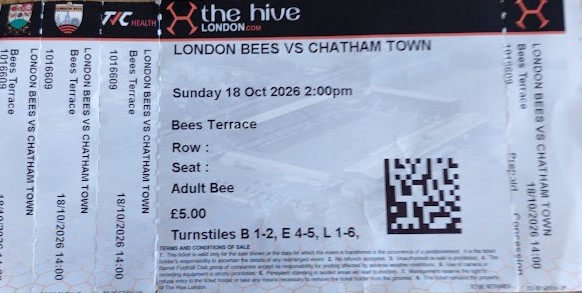
The game against Chatham Town started with the Bees on the attack and almost an early chance. With no scoreboard or screen, it is sometimes hard to remember the exact score if there have been a lot of goals or to be sure how much time is left in the game. We did get a professional ticket – which I think is how the FAWNL League can report the exact numbers of attendees. Each ticket only cost £5 ($6.70). There is a QR code which can be scanned in to enter the “ground” – it is just a pitch with a stand.
I will say that the Management has been improving the facilities each season. The Hive itself is a large sporting complex in Edgware, North West London. It has a stadium where AFC Barnet play with around 4,000 to 5,000 attendance. There are multiple small pitches for both five-a-side leisure games as well as facilities for professional athletes. There is both a bar and a café and a venue where I have seen weddings and other ceremonies take place before.
Back to the game – this game did ebb and flow including one part of the game where nothing seemed to happen and it was more in the middle of the pitch. According to the official match report, the structure of the game was in the London Bees having most of the possession and Chatham Town trying to hit them on the break. In the first half, Chatham Town’s right winger was especially effective and pacy although she lost her threat in the second half.
The London Bees had a lot of chances but could not find the back of the net until centre-back Grace Breen headed in from a corner in the 85th minute, her third goal in 10 games so far this season.
Immediately after the goal, Chatham Town switched to a long-ball approach and violent attacking. Incredibly, this almost paid off with them hitting the bar from a free-kick. However, the Bees were able to hold on and keep the lead to end up staying top of the Table!
Since the game, they were beaten 2-0 away to QPR meaning they now sit in second place, one point behind the Leaders Actonians who they will play later this month.
Being in such a small venue, I actually got involved in the game briefly when the ball came into the stand and I collected it and threw it to the Bees defender Aria Heil for her to take a throw-in. It was also nice that we could simply walk to the other side of the stand in the second half so we could be by the goal that the London Bees were attacking. As a lot of the fans were Chatham Town fans, this was easy to do with no space concerns. Plus in the second half, one of my friends went over to collect the ball which had fallen behind the metal fencing. This is the life of non-League football. Everyone has to get involved.
Summary
Watching your local non-League Team can be a rewarding experience and now you have a real understanding of how the Women’s Football Pyramid works and you can see the promotions and relegations across the Pyramid. You also have a better understanding of all of the teams below the WSL and so can hopefully go and support your local team.